

Use range search when what matters is how similar a result is, not just how many results you get back. A plain top-k search always returns k neighbors, even when the nearest one is a poor match; range search (also called radius or threshold search) only returns vectors whose distance or similarity score falls inside a bound you set. That makes it the right tool for deduplication, “no good answer” detection in RAG, match/no-match decisions such as image or face matching, and any workflow that needs a similarity floor. In Milvus you add radius and, optionally, range_filter to an ordinary search, and limit still caps the number of results.
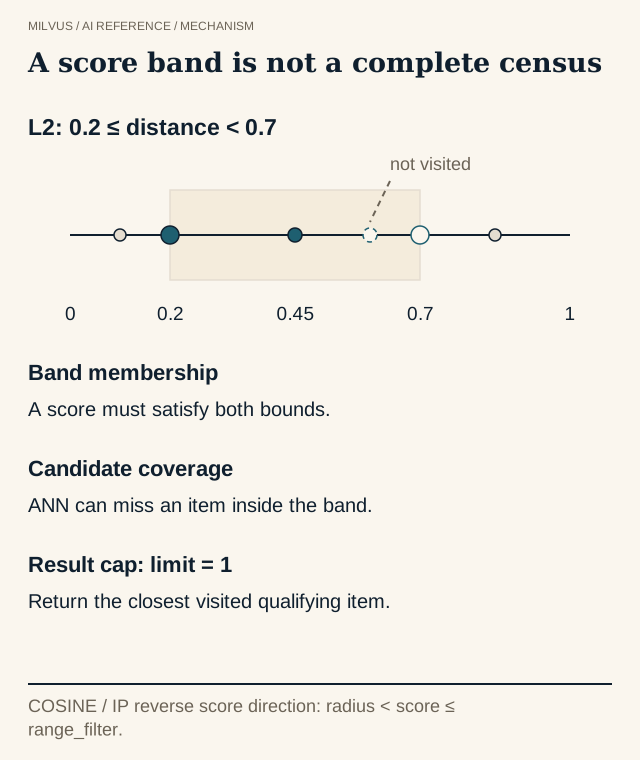 Range search adds a score condition. For COSINE / IP the band is radius < score <= range_filter.
Top-k vs range search
| Top-k search | Range search | |
|---|---|---|
| Question it answers | “What are the k most similar items?” | “Which items are at least this similar?” |
| Result count | Always k (if the collection has k eligible items) | Anywhere from zero to limit |
| Weak matches | Returned anyway when nothing better exists | Excluded by the threshold |
| Main parameter | limit | radius (plus optional range_filter) and limit |
| Needs calibration | Rarely | Yes, per model and metric |
| Typical uses | Search results pages, RAG context, recommendations | Dedup, match decisions, similarity floors, “nothing relevant” detection |
The two are often combined: fetch the top k, but only among results above a similarity floor.
How does range search work in Milvus?
Milvus runs a normal ANN search with the collection’s index and metric, keeps only results whose score falls in the band defined by radius and range_filter, and returns up to limit of them, best first. Think of two concentric circles around the query: radius is the outer boundary (how far is still acceptable), and range_filter is an optional inner boundary that excludes results that are too close, such as exact copies of the query.
The direction of the inequalities depends on whether the metric is a distance (smaller is closer) or a similarity (larger is closer):
| Metric | Closer means | Condition on returned results |
|---|---|---|
L2 | Smaller distance | range_filter <= distance < radius |
IP | Larger score | radius < score <= range_filter |
COSINE | Larger score | radius < score <= range_filter |
JACCARD | Smaller distance | range_filter <= distance < radius |
HAMMING | Smaller distance | range_filter <= distance < radius |
So with COSINE, radius is the lower similarity bound and range_filter the upper one; with L2, radius is the upper distance bound. Copying a threshold from one metric to another silently inverts its meaning. See cosine, inner product, and L2 for how the metrics relate.
results = client.search(
    collection_name="articles",
    data=[query_vector],
    anns_field="embedding",
    limit=50,
    search_params={
        "metric_type": "COSINE",
        "params": {
            "radius": 0.80,        # keep results with cosine > 0.80
            "range_filter": 0.995  # drop near-identical copies above 0.995
        },
    },
    output_fields=["title"],
)
Three behaviors are worth remembering:
limitstill applies. If 5,000 items clear the threshold andlimitis 50, you get 50. A single search request caps topK at 16,384; for larger result sets, the Milvus docs recommend a SearchIterator.- It is approximate. Range search sits on top of the ANN index, so an item inside the range can be missed if the index never visits it, just as in top-k search. Search effort parameters such as
efornprobestill matter. - Filters combine normally. Add a
filterexpression to restrict eligibility (tenant, language, date) and the threshold applies to what remains.
When is range search the better choice?
Near-duplicate detection. For each new item, ask for everything above a high similarity threshold. Items that return nothing are novel; items that return matches go to a review or merge step. A similarity score does not prove two documents are interchangeable (a changed number, version, or permission can matter even when vectors are almost identical), so treat hits as candidates. For text, MinHash LSH is a complementary path that targets literal overlap.
Guarding RAG against irrelevant context. Top-k always fills the prompt, even with off-topic passages when the knowledge base has nothing relevant. A similarity floor lets the application say “no relevant documents found” or route the question elsewhere instead of feeding weak context to the model.
Match / no-match decisions. Image matching, face verification, and entity resolution often need a binary answer. Szilvasy, Mazaré, and Douze argue these workloads should be evaluated with range-search metrics rather than top-k recall, because the decision depends on the distance, not the rank.
Recommendations with a quality bar. Return “more like this” only when items are genuinely close, and fall back to popular items otherwise.
Excluding the query itself. When searching with an item that is already in the collection, range_filter can drop the item and its exact copies while keeping close neighbors.
Top-k alone is fine when every query is expected to have useful neighbors and the consumer just needs a ranked list, as on a typical search results page.
How do you choose the threshold?
There is no universal number. A cosine of 0.8 means different things for different models: some embedding models spread unrelated texts around 0.1, others cluster everything above 0.6. Thresholds also shift with normalization, domain, text length, and model version. Calibrate them:
- Collect labeled pairs. Gather clear matches, clear non-matches, and hard negatives (similar-looking but different, such as two product variants or two versions of a policy).
- Score them with the exact model and metric you will deploy.
- Sweep the threshold and plot precision (accepted pairs that are real matches) against recall (real matches that are accepted).
- Pick the operating point your application can live with. Deduplication that deletes data needs high precision; a RAG relevance floor can tolerate more false positives.
- Separate threshold error from ANN error. Run the same queries on a
FLATindex and compare. IfFLATfinds an in-range item that the ANN index misses, increase search effort; if both accept a bad pair, the threshold or model is the problem. The FLAT baseline guide covers this setup.
Store the threshold next to the model name and version that produced it, and recalibrate after re-embedding. Also test the edges: queries with zero results, dense clusters where more items qualify than limit allows, and scores sitting right at the boundary. Decide in advance what the user sees when nothing qualifies.
Common mistakes
- Reusing an
L2radius withCOSINE(or the reverse) and getting the inequality backwards. - Using
IPwith unnormalized vectors and expecting scores in a fixed range. - Assuming range search returns every qualifying item, when
limitand ANN approximation both cap it. - Picking a threshold from a demo instead of from labeled data, then never revisiting it after a model upgrade.
For measuring the result, see how to evaluate retrieval quality and how embeddings help with deduplication.
To try it, load sample data with the Milvus Quickstart, then add radius and range_filter to a search as shown in the range search guide.


